
*These are my personal reflections, not an official company statement.
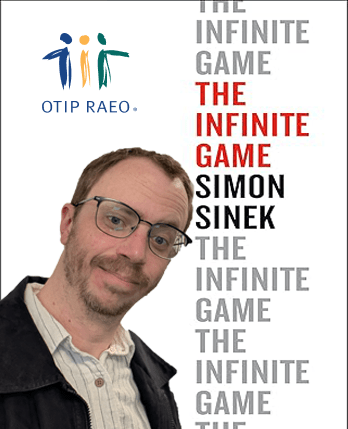
When I joined OTIP, I was prepared to ease into a new routine, learn their ways, and maybe decorate my desk with something silly like an artistic mousepad. What I wasn’t expecting was to find myself rethinking what leadership looks like and how a workplace can feel more like a community than a company. And I don’t mean in an ingratiating or placating way, but an actual engagement of people. It was at my first all in that a director suggested to read The Infinite Game by Simon Sinek. His ideas landed differently because I could already see versions of them happening around me in OTIP.


1. Playing to Keep Playing
Sinek talks about how some pursuits have no clear finish line. Leadership, service, purpose – they’re less like games you win, more like stories you keep writing. And that idea felt surprisingly familiar.
At OTIP, nobody handed me a list of KPIs to hit or competitors to crush. I walked into a place grounded in a mission: to protect what matters most to members. It’s not something you “win.” It’s something you uphold. There’s a kind of calm determination in that; like we’re not scrambling to prove ourselves, but showing up to build something worth returning to.
2. Living the Cause
A Just Cause, according to Sinek, is what keeps people motivated beyond paychecks and job titles. It’s what gets them to care on a Tuesday afternoon when no one’s watching.
For me, that showed up early. During onboarding, it wasn’t just checklists and login credentials. It was a sense of presence – real engagement with the community. The office is full of small but deliberate reminders: charity drives, volunteering encouragement, updates about local outreach. That kind of visible commitment builds trust, because it shows we’re not just talking about supporting others – we’re structured around it.
It made the mission feel lived-in, not laminated.
3. Trust Starts at “Hey, How Are You?”
One of the more immediate things I noticed was how easy it was to ask for help. Not just procedural stuff, but the awkward, human stuff too – “I think I messed this up,” or “I’m not sure what’s expected here.” That’s not always a given.
People here actually care. “Caring is our Culture” isn’t framed on the wall like an old diploma. It’s in the tone of feedback, the way wellness tools are promoted without guilt, and how managers make room for questions. It’s not performative – it’s practiced.
I’ve felt it most in the meetings and daily interactions that make up the rhythm of the workday. When someone admits they’re unsure, or asks a question that’s maybe a bit vulnerable, they’re met with patience not posturing. That kind of response builds psychological safety, which is the foundation of real trust.
4. Rivals as Mirrors
There’s a chapter in the book about seeing rivals not as enemies, but as people you can learn from. You watch what they’re doing, not to mimic or outpace, but to grow.
That mindset is baked into how OTIP evaluates and improves. We’re not just picking tech because it’s shiny – we’re making thoughtful comparisons. The switch to NICE, for example, came from asking whether our tools are actually serving people well. It’s not about chasing trends. It’s about using what fits us and fits the people we’re trying to support.
The questions we ask don’t start with “how can we win?” but with “how can we work smarter for the people depending on us?”
5. Being Willing to Pivot (With Purpose)
Sinek describes “existential flexibility” as the willingness to shift your strategy without betraying your core beliefs. It’s a hard thing to get right.
But I’ve seen it in how OTIP handles data. There’s a serious emphasis on getting to the “why” behind the numbers not just what they show, but what they mean. The conversation isn’t just about reporting; it’s about insight. We’re asked whether something is actually useful, or just easy. That kind of questioning feels empowering, because it says: we care more about understanding than looking polished.
It’s a permission structure for thoughtful change – the kind that adapts with purpose.
6. Doing the Hard Thing When It’s the Right Thing
One of the quieter strengths I’ve noticed is how OTIP handles integrity. Whether it’s around protecting personal data or the tone used with members who are having a hard time, there’s a sense that ethical choices aren’t negotiable.
That kind of courage – the slow, steady kind – doesn’t always grab headlines, but it builds trust over time. It also models something I hope to embody in my own work.
But more than that, there’s space for vulnerability here. Our internal platform, Pulse regularly features people sharing personal stories often including sensitive or difficult experiences. These aren’t sanitized highlights; they’re real. And the response isn’t avoidance or awkward silence, it’s encouragement and gratitude. It’s proof that OTIP doesn’t just say it values courage – it holds space for it. And that kind of environment makes it easier to be brave ourselves.
Final Thoughts
Reading The Infinite Game gave me a lens. Being at OTIP gave me examples.
I’m still finding my rhythm here, still learning how I can contribute. But I already feel like I’m part of something with depth, not just direction. This isn’t a place obsessed with being the best. It’s a place committed to doing its best consistently, collaboratively, and with a whole lot of care.
And that’s the kind of game I want to keep playing.
 Michael Kellett - Mym111
Leave a comment