
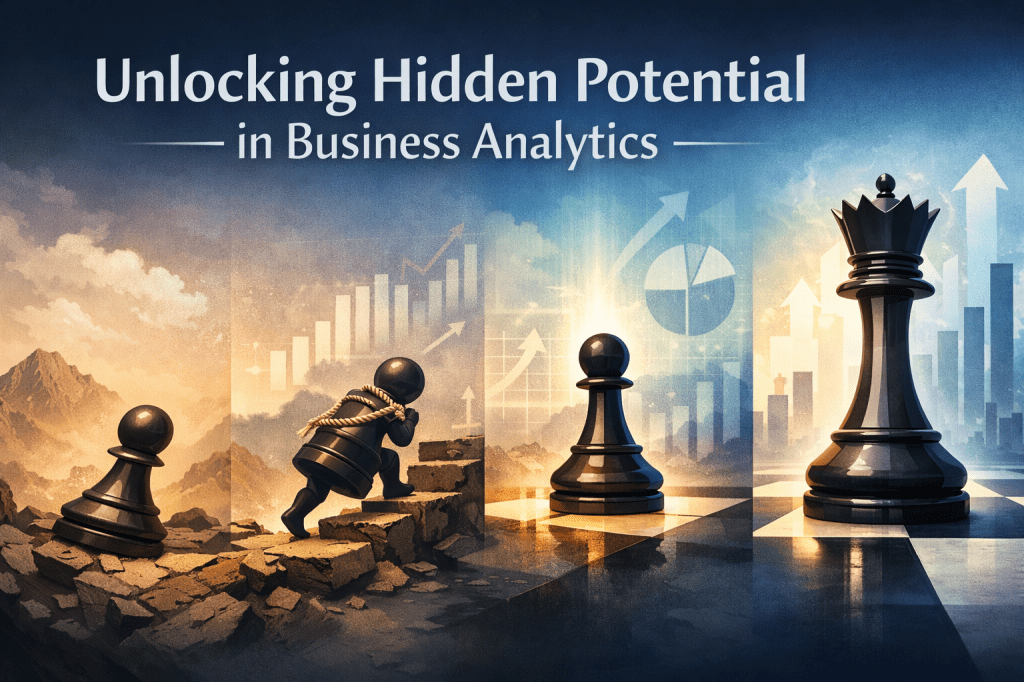
What does “Potential” Actually Mean?
There’s a comfortable story we tend to tell about talent. That some people just have it. They’re naturally analytical, naturally technical, naturally suited for the kind of work we do in business analytics.
It’s a nice story. It’s also a limiting one.
In Hidden Potential, Adam Grant challenges that idea pretty directly. His argument isn’t that talent doesn’t exist, it’s that we massively overvalue it. What actually drives long-term performance is something far less glamorous:
The ability to improve, consistently, over time.
Or more bluntly: getting better at getting better. In analytics, that hits close to home. Because the tools change, the data changes, the business changes, and if your value is tied only to what you already know, you’re on borrowed time.
So the real question becomes:
what actually helps someone grow in a system that never stops moving?
Grant’s answer breaks into three parts:
- Character (how you learn)
- Motivation (how you sustain effort)
- Systems (whether growth is even allowed to happen)
Skills of Character: Learning When It’s Uncomfortable
There’s a moment that shows up in almost every analytics workflow. Something doesn’t make sense. The data looks wrong. The query isn’t behaving. The result contradicts what you expected. And in that moment, you have two options:
- protect your ego
- or get curious
Grant leans hard into the second.
Advice > Feedback
There’s a perspective here that changes how people respond to you.
“Do you have any feedback?” tends to invite judgment.
“What would you suggest I try next?” invites collaboration.
One is retrospective. The other is forward-moving. In analytics, where so much of the work is interpretation, that distinction matters. You’re asking how to make it better for the next iteration.
Discomfort is the signal
We tend to avoid the parts of learning that feel slow or awkward. Reading documentation. Debugging line-by-line. Rewriting something from scratch. But those are usually the exact moments where skill is being built. There’s a temptation to stay in what feels fluent, to operate where things are smooth and familiar. But fluency can be deceptive. It can feel like progress while quietly slowing it down.
If something feels uncomfortable, there’s a good chance you’re exactly where you need to be.
Humility as a practical skill
Humility sounds abstract until you try to use it. In practice, it looks like:
- sharing work before it’s polished
- stating your assumptions out loud
- letting someone else point out what you missed
That last one is the hardest, but it’s also the fastest way to improve.
A useful reframing here is thinking in terms of “mistake budgets”, treating mistakes not as failures, but as expected steps in the process. The goal is to encounter them early, when they’re still easy to fix.
Structures for Motivation: Sustaining the Work Without Burning Out
If character is about how you approach learning, motivation is about whether you can keep going, and this is where a lot of analytics teams quietly struggle because the work can drift into two extremes:
- overwhelming complexity (burnout)
- repetitive stagnation (boreout)
Both are equally damaging.
Deliberate play vs. endless grind
There’s a difference between doing work and developing skill. Grant introduces the idea of “deliberate play”, structured practice that keeps things engaging enough to sustain over time. In an analytics context, that doesn’t mean turning work into a game. It means introducing small, intentional challenges:
- solving the same problem in multiple ways
- redesigning a dashboard for clarity rather than just accuracy
- actively searching for data inconsistencies
It’s about making improvement visible.
Flow as a feedback system
We tend to think of flow as something rare or ideal, but it’s actually diagnostic.
- If the work is too easy → boredom
- If it’s too hard → anxiety
- If it’s balanced → engagement
When someone consistently falls outside that middle space, it’s usually not a personal issue. It’s a mismatch between skill and challenge which means motivation is something that can be designed.
Systems of Opportunity: Where Growth Either Happens… or Doesn’t
This is the part that’s easiest to overlook because it’s about the environment. You can have all the right habits, all the right intentions, and still struggle if the system around you doesn’t support learning.
Rethinking how ideas are shared
Traditional brainstorming tends to reward the fastest or loudest voice, which means a lot of ideas never surface. Having people think independently before sharing can dramatically change the quality of discussion. It gives space for quieter or less certain ideas to exist without immediate pressure.
And in analytics, those half-formed ideas are often where the real insights begin.
Collective intelligence over individual brilliance
There’s a strong cultural pull toward the “data expert”, the one person who knows everything and solves everything, but teams improve by distributing knowledge, not centralizing it.
Balanced participation, active listening, and shared problem-solving actually produce better outcomes.
Psychological safety as infrastructure
This is one of those ideas that sounds soft until you see the alternative. If people don’t feel safe saying “I don’t know,” they won’t say it. And when uncertainty goes unspoken, it doesn’t disappear, it just moves downstream where it becomes harder to detect and more expensive to fix.
In analytics, that’s how small misunderstandings turn into flawed metrics, misinformed decisions, and real-world consequences. So psychological safety is operational.
The Compounding of Better Questions
We tend to imagine potential as something hidden inside individuals, but in practice, it looks more like a pattern.
Someone asks a slightly better question.
Someone else challenges an assumption.
A third person connects two ideas that didn’t quite fit before.
And over time, that compounds. Not into perfection, but into something more useful: A team that learns faster than the problems it’s trying to solve.
Not that anyone can become exceptional overnight, but that, given the right habits and the right environment, improvement becomes inevitable. And in a field like business analytics, that might be the only advantage that actually lasts.
That’s the real takeaway from Hidden Potential.
 Michael Kellett - Mym111
Leave a comment